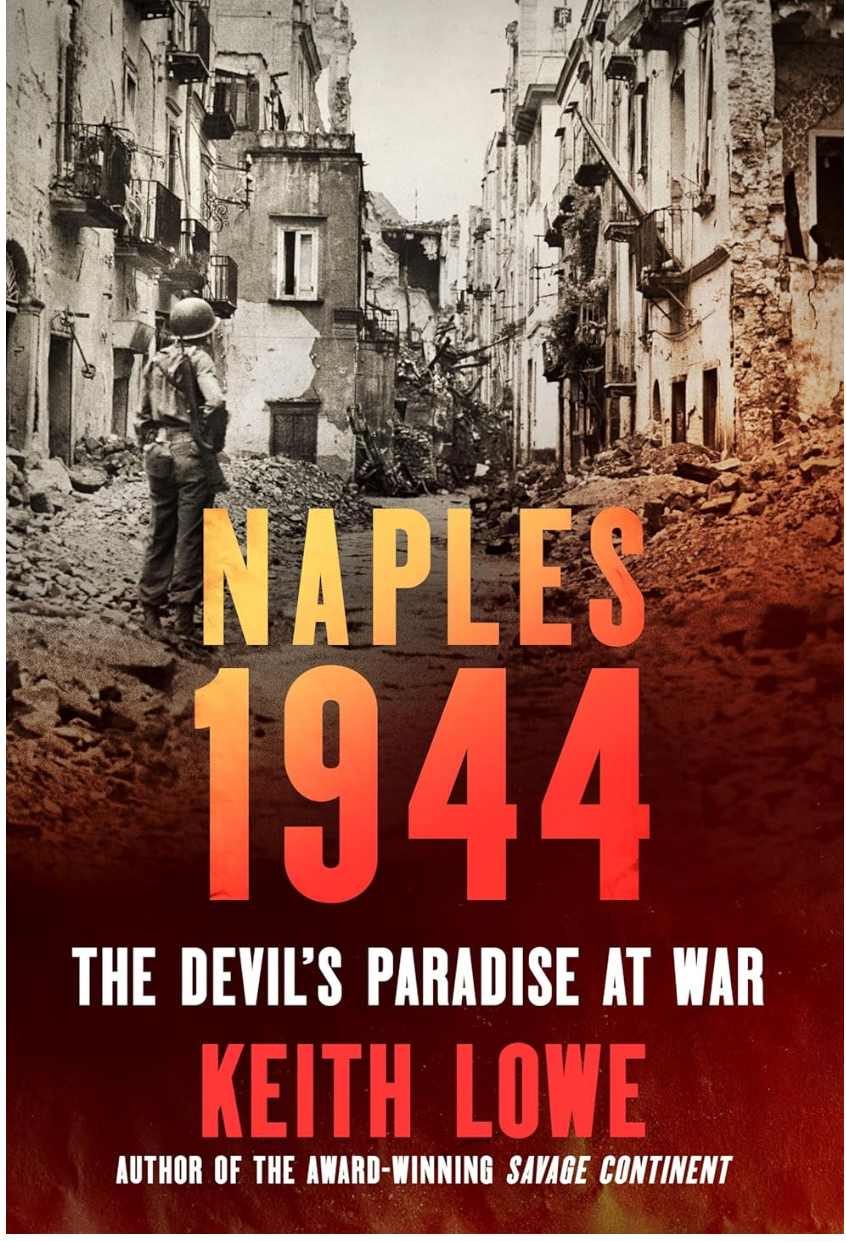
Naples has a history issue: there is too much. Conquered by many regimes, the people of Naples have always held the will to fight but lacked the general means to do—the southern Italian city has always been viewed as the underdog, especially by its peer cities to the north. Lowe’s book opens the curtains for just two years of Napolean history—in the grand scale a mere blink—however, I was pleasantly surprised at how much Naples 1944 was able to cover and unpack.
The American war machine, pulling up on the shores of southern Italy, quickly extinguished the German defenses and set up a pseudo-European headquarters in Naples. After telling the story of the Allied forces charging through German lines, Lowe’s research and writing then divides each chapter into specific topics that cover Naples' mass disarray which occurred during both German and American occupation. At a certain point, it seemed as if the people of Naples, thanks to their weak representatives, were stuck between choosing the lesser of two evils: a despotic German rule, which held randomized mass executions; or an American occupation which resulted in extreme economic turmoil, disease, and famine to the point of starvation. The latter did not result from cruel intentions. Instead, the British and Americans simply found themselves out of their depth—applying simple capitalistic measures to a city with historical roots deeper than America’s oldest tree created an environment more toxic than Gordon Ramsey’s Hell’s Kitchen.
I was recently fortunate enough to visit Naples for a quick seventy-two hours (not nearly enough time). A big surprise from my time exploring was the general lack of cleanliness. I live in San Francisco, so I am used to certain streets being less than tidy, but Naples was on a different level. Reading Naples 1944 provided much needed context as to why so much of Naples’ infrastructure was failing. Eighty years has passed since World War II ended, and yet the overcrowding, lack of jobs, and corrupt government officials lining their pockets set Naples back from ever full recovering. Nonetheless, the city is on the up and up—crime statistics show that peer cities in the north (Milan, Rome), are now more dangerous than Naples. This can either mean that Italy is simply more dangerous, or, in a more optimistic lens, that Naples is slowly mending.
Publisher : St. Martin's Press
Publication date : March 11, 2025
Language : English
Print length : 464
Share this review:
We may earn a commision when you buy products through the links on our site.